
AI slop: what it is, why Google is burying it, and how to avoid it
 Studio11 min read
Picture this: someone searches Google for how to solve a specific problem in their industry. They open twenty tabs. All twenty articles say exactly the same thing. The same five generic tips. The same structure. The same clean, balanced tone that says nothing.
That person closes every tab and searches again. But this time they add one word at the end: reddit. They want to hear from someone who has actually been through it.
That is exactly what we are going to look at today.
I'm a heavy AI user
I use it daily to research, structure drafts, and accelerate what used to take me twice as long. I'm coming from the inside, from real use, to explain why the internet is turning into a sea of identical texts and why that, far from being a problem for you, is the best opportunity you have had in years.
The promise was beautiful: tools that would democratize content creation. But nobody anticipated the obvious side effect. When everyone uses the same tool, everyone publishes the same thing.
AI slop: the processed food of content
Imagine walking into a supermarket where every brand is the same brand with a different label. Same taste, same look, same texture. That is the internet right now in many verticals.
AI slop is the name that has stuck for the phenomenon: content mass-produced by AI that saturates digital channels. It's not that it's technically badly written. The problem is that it has no perspective. No lived experience. None of that spark that only appears when someone has actually wrestled with the problem they are talking about.
And we're not talking about a minor trend. A Graphite analysis, based on 55,400 English-language URLs from Common Crawl, measures exactly what's happening in the world of online articles: twelve months after ChatGPT's launch they were already 35.9% of total publications. In Q1 2025 they hit 49.6%. In Q4 2025 they surpassed human-written articles for the first time at 50.9%. And in Q1 2026 they sat at 49.9%. Translation: in the field of online articles, synthetic production now competes head-to-head with human writing. The tide hasn't gone away, it has simply plateaued near 50% and has stayed there for over a year. And that figure, even though it has stopped climbing, is still enormous. In December 2025, more than one million YouTube channels were using AI creation tools daily.
Think about the last time you searched for a solution to a specific problem. You probably ran into twenty articles saying exactly the same thing, with the same five generic recommendations. And then, if you got lucky, you found a post by someone telling you how they solved that problem themselves, with specific details, errors included, and lost hours documented. Which one was useful?
The second one. Always the second one.
Perfection has become suspicious
There is a cultural shift most people haven't seen yet. Five years ago, a polished, balanced, correct text built trust. Today it triggers alarms. It sounds like a machine. And machines don't sign with their reputation.
The human brain has become a synthetic-text detector without anyone teaching it. It picks up the neutral cadence. It picks up the lists that always have three or five points. It picks up the balanced closings that say nothing. It picks up the absence of friction.
And here's the uncomfortable twist: content that is too correct has become the new signal of low quality. Spelling mistakes used to mark the amateur. Today, stylistic perfection marks the generated.
One important nuance. The statistics say 75% of consumers cannot consciously distinguish human content from AI-generated content. But consciously distinguishing and reacting the same way are different things. The brain doesn't need to identify the culprit to lose trust. And that distrust isn't paranoia: every week new real AI failure cases are documented, from deepfakes used for fraud to fabricated answers reaching millions of users per minute. The brain processes that before being able to articulate why. It reacts with disinterest, with a quick back-button click, with a scroll to the next result. The algorithm picks that up. And according to Graphite's own analysis, much AI-written content simply doesn't rank.
If your text could have been written without you existing, it doesn't add anything that a hundred other sites aren't already adding.
Your failures are literally worth gold
This is your real competitive advantage. Any tool can generate a manual on ten steps to grow your business. Only you can write how you lost a thousand euros with one client and what you would do differently today.
Google has been pushing a similar idea in its public documentation for years. Producing correct text isn't enough. What matters is whether the content is useful, reliable, made for people, and backed by signals of experience, expertise, authoritativeness and trustworthiness. EEAT stands for Experience, Expertise, Authoritativeness and Trustworthiness. It's not an algorithm or a direct ranking factor. It's the framework Google's human raters use to evaluate content quality, and their judgment then trains the actual systems. Important: Google doesn't penalize AI for being AI. It penalizes content that is unhelpful, automated, or created primarily to manipulate rankings, regardless of origin. The first E, Experience, is key because it separates text informed from the outside from text written by someone who has lived, tested or suffered what they're explaining.
I've documented this on my own blog. I ran an experiment where I presented a technically suicidal project to the six most advanced AIs on the market to see if any of them would stop me. None of them did. They all validated a disaster. That article, where I explain exactly what happened and why, works because there is a real experiment behind it. If I had written it as AIs sometimes validate bad projects, be careful, nobody would have read it. The difference between the two versions is that one has skin in the game and the other doesn't.
When you share a failure, you're not showing weakness. You're demonstrating three things that both the algorithm and the reader pick up: you've been in the trench, not just read about the topic; you have the judgment to analyze what went wrong; you're honest enough to admit it publicly with your name on it.
That combination produces something no synthetic content can produce: genuine authority. And genuine authority is the only thing that turns readers into clients, followers, and community.
The uncomfortable opinion: your superpower in 2026
AI tools are trained to be neutral. By design. They present every side of an argument. They never commit. And precisely because of that, they never stand out.
There's a pattern that repeats in every model: faced with any controversial question, it opens with it depends on the context, closes with the important thing is to find balance, and in the middle stacks five perspectives that don't commit anyone. It's a safe text. It's also an invisible text.
You can say things the machine will never say. I've tried these five tools and four are a waste of time. This common practice in my industry has been obsolete for three years. This trend everyone defends is hot air and here's the data.
It's about having a grounded position and defending it with your name on it, knowing some people won't agree. That willingness to put reputation on the table is what AI doesn't have, not for technical reasons, but because it literally has no reputation to put down.
In an ecosystem saturated with half-measures, the one who commits with solid arguments takes the attention.
Using AI without losing your voice
Here's the part most people don't want to hear: the debate over whether using AI makes you an impostor or rejecting it makes you authentic is intellectual laziness.
The key is understanding what the machine does well and what only you can do.
AI is good for | Only you can do |
|---|---|
Initial drafts that save you from a blank page | The specific anecdote that illustrates the concept |
Researching and summarizing across multiple sources | The nuance only someone who's lived it knows |
Optimizing the structure of what you've already written | Taking a clear stance on something controversial |
Suggesting angles you hadn't considered | Connecting ideas based on your trajectory |
Accelerating the mechanical and the repetitive | Signing your name and taking the risk |
The right workflow in 2026 isn't human vs. machine. It's machine for speed, human for judgment. Let AI handle the initial research and the base structure. But the signature, the anecdote and the opinion that commits stay with you.
If you run the filter and removing your personal signature doesn't change anything in your text, it's because there was nothing of you in there to begin with. And that is exactly AI slop with your name on top.
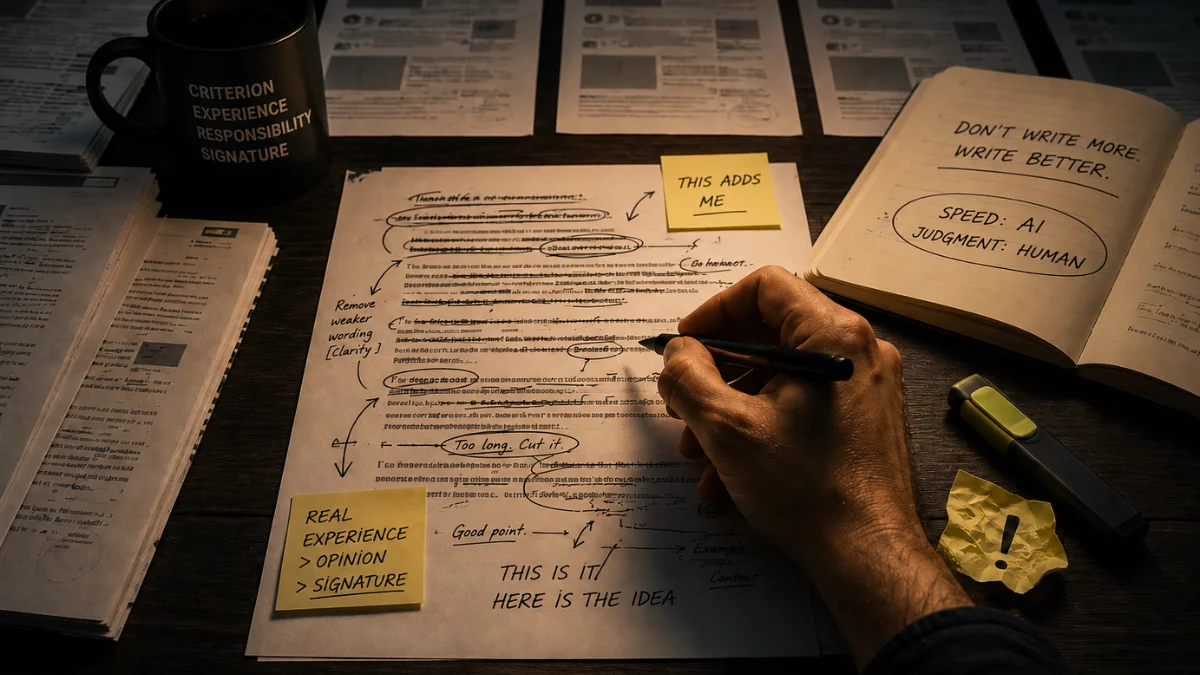
AI brings the speed. You bring the judgment. Without that final layer, the text is just slop with your name on it.
Human content has become a luxury product
We're in a paradoxical era. Producing technically correct content has never been cheaper. Producing content that actually connects, builds authority and generates trust has never been more valuable.
It's the food logic. Industrial processed food is in every supermarket at minimum price. If you want a dish made with quality ingredients, refined technique and a chef's personal touch, you pay more. Because you know there's something behind it that can't be fully industrialized.
Your informed opinion, your documented experience, your ability to see connections others miss: that is the digital equivalent of that dish. And as AI keeps taking up more surface of the content ecosystem, human differentiation only becomes more expensive.
You don't need to compete with the machine on speed or volume. Compete on depth, on nuance, on honesty. It can't catch you there, no matter how advanced it gets.
The window is still open
While millions of pages fill up with clonic synthetic content, there's a huge gap for those willing to think, experiment and share real results. Algorithms increasingly reward genuine experience. Audiences are starving for voices that don't sound corporate. The businesses that build real authority are the ones that survive when the rules of the game change.
There's an interesting signal in the data. After mid-2025 human-generated content has started to recover ground versus the synthetic, probably because automated texts perform worse in search engines and conversational systems. The tide isn't stopping, but the filter is sharpening. The market is relearning how to distinguish.
You don't need to be the biggest or the fastest. You need to be the most real. And that, ironically, is something only humans can be.
Frequently Asked Questions
What exactly is AI slop and why should I care?
It's content mass-produced by AI, technically correct but with no differential value. You should care if your strategy depends on organic ranking or brand authority. It's getting harder to stand out among thousands of pages saying exactly the same thing. And search engines are tuning their filters specifically to detect and bury that kind of content.
How do I use AI without ending up publishing AI slop?
AI slop isn't content written with AI's help. It's content written without anyone putting human judgment into it. You can use AI as a first-draft accelerator, a structured research tool, or a style editor, and still publish something deeply yours. What you can't do is publish whatever the model spits out without touching it and expect it to add anything.
How do I know if my own content is falling into AI slop?
Here's a quick test. Remove your signature. If the text could have been written by any other person in your industry without changing anything, it's AI slop with your name on top. If inside there's a specific anecdote only you could tell, a data point you pulled from a real experiment, an opinion you're taking reputational risk on, then yes, you have human content.
Is it worth still writing when AI produces infinite content for free?
More than ever. The cheaper generic production becomes, the more expensive the difference becomes. The niches where trust matters, which are basically all the ones moving real money, reward the human who commits. AI floods the floor of the market, but the ceiling, where brand and authority are built, remains human territory.
Final reflection
There's something this article doesn't say explicitly but pulses in every section. The problem has never been AI. The problem is the human laziness that uses it to skip the most important step.
The machine writes fast. That's a fact. But the machine doesn't decide what to write about. It doesn't choose what position to take. It doesn't sign with a first and last name. It doesn't lose money when it gets it wrong. It has nothing to lose because it has nothing on the table.
You do.
And precisely because you do, what you write carries a weight nothing mass-produced can match. The AI industry will keep improving technically. What will never improve is its capacity to hold convictions, to pick a side, to put reputation on the table.
That is still your home. Don't abandon it.
Sources
Data | Source |
|---|---|
Definition and features of the AI slop phenomenon | Cyberclick, AI Slop: low-quality AI-written content is killing the internet |
Quarterly shares of English-language online articles primarily AI-generated (Q1 2025: 49.6%; Q4 2025: 50.9%; Q1 2026: 49.9%) | |
More than one million YouTube channels using AI tools daily in December 2025 | |
75% of consumers cannot consciously distinguish human content from AI-generated content |
Related articles

ChatGPT Can Cost You a Sale Before the Click
Some sales are no longer lost on your website. ChatGPT can compare, reject and recommend before the click, leaving no visit, no abandoned cart and no trace in your dashboard.

How to turn your content into audio without setting up a studio
Turn any Studio article, social adaptation or free-editor text into natural audio. Own engine, curated voices, free samples and pay-per-word, right from the same button.

Answer Capsules: How to Structure Content So AI Can Cite It
Answer Capsules structure content so RAG systems can extract, cite and measure its impact on visibility, MQLs and pipeline when traditional attribution fails.
Found this useful? Share it with someone who needs it!