
How Google Knows Whether AI Wrote Your Content
 Studio14 min read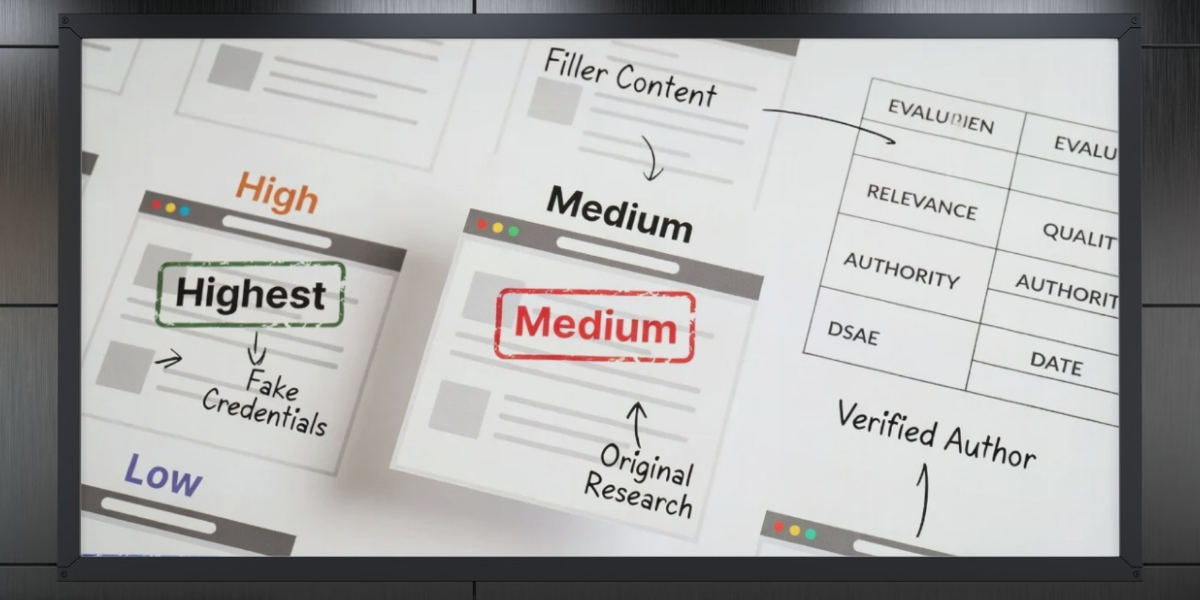
Generative AI has flooded the web with content at a scale no one had seen before. Google has been building its response for some time, and by 2025 that response had become more concrete, more technical, and harder to ignore. The search engine does not penalize AI-generated content simply for existing. What it penalizes is something more specific, harder to dodge, and in a certain sense more fair: the absence of real value for the reader.
Understanding which signals Google evaluates, who evaluates them, and what happens when you ignore them can be the difference between establishing yourself as a credible voice in your field or disappearing from the results for months.
The Team Google Almost Never Talks About
Before getting into algorithms, it helps to understand the infrastructure behind them. Google works with around 16,000 search quality evaluators commonly called quality raters who are external contractors hired to manually review samples of real search results. Their scores don't directly change any page's ranking, but they do feed the machine learning systems that do.
The document that guides their work is called the Search Quality Rater Guidelines (QRG), and Google updates it regularly. The January 2025 revision introduced significant changes to how low-quality content is detected and categorized, with particular attention to AI-generated content published without human oversight. The September 2025 update added clarifications on AI Overviews and expanded the definition of sensitive topics the so-called YMYL category, covering content that can affect your money, your health, or your safety to include elections, civic institutions, and government processes.
These raters have one specific job that matters here: deciding whether a page deserves to be rated Highest, High, Medium, Low, or Lowest. Landing in the Lowest category is not a technical problem. It is an editorial one.
16,000 human evaluators manually review samples of real search results. Their ratings don't change rankings directly — but they train the models that do.
The Internal Google Team Working on AI Content
In January 2025, SEO consultant Gagan Ghotra shared a screenshot on X of the LinkedIn profile of Chris Nelson, Senior Staff Analyst for Search Ranking at Google. In his job description, one line quickly became a reference point across the industry: "Address novel content issues (e.g., detection and treatment of AI-generated content)."
Nelson is also a co-author of Google's official policy on AI-generated content. His profile made fairly clear what many had already suspected: Google has dedicated teams specifically focused on detecting and managing AI content. Not as a pilot program as an established part of normal operations.
Google's official position is that AI content doesn't violate its policies simply by existing. What can violate them is using it with the sole purpose of manipulating search results without providing any genuine value. The distinction sounds small. In practice, it isn't.
What Raters Actually Look For When They Review a Page
Google identifies five patterns that lead to the worst possible rating: Scaled Content Abuse, Fake E-E-A-T, Filler Content, Low Effort Main Content, and Deceptive Design. Any one of them can place a page in the Lowest category, regardless of its previous ranking.

A web page cross-sectioned into layers under a magnifying glass. Each stratum represents a practice Google identifies as a low-quality signal — and that its raters are trained to spot.
The QRGs updated in January 2025 replaced the older section on auto-generated content with a more detailed framework. The Lowest rating — the worst possible — tends to apply when a page falls into one of these patterns:
1. Scaled Content Abuse
Using automated tools, including AI, to produce large volumes of pages that offer no real value to the reader. This is an official Google term, documented in its Spam Policies. Google's Search Liaison Danny Sullivan put it plainly in a public session: We don't really care how you're doing this content at scale, whether it's AI, automation, or humans. It's going to be a problem.The criterion isn't which tool you use. It's whether what you publish adds anything.
A straightforward example: if you publish 200 articles a month on the same topic and none of them says anything that isn't already on the first page of Google, it doesn't matter whether a person or an AI wrote them. Google treats it as spam at scale.
2. Fake E-E-A-T
The January 2025 update added a section on fake E-E-A-T, expanding section 4.5.3 to cover three types of deception: false business information (such as implying you have a physical location when you don't), author profiles that are invented or AI-generated, and professional credentials that simply aren't real. A medical site claiming its author is a doctor when they aren't can end up rated Lowest even if the content itself is technically accurate.
A concrete example: if you run a nutrition blog and your author bio says "Certified Dietitian" without that being true, that is exactly what this category covers.
3. Filler Content
Content that artificially inflates a page without adding real substance. The QRGs specifically call out AI's tendency to produce text that looks information-rich but delivers no concrete value to the reader. The practical test: if you cut half the text and the page still answers the same question just as well, that half was filler.
Think of a work report that runs 20 pages when the actual content fits in 5. The other 15 exist to look thorough.
4. Low Effort Main Content
If virtually all of a page's content was generated by AI with no editorial effort, no originality, and no independent judgment, the rating tends toward Lowest. The QRGs are clear on this: citing sources at the bottom doesn't save a page if the content itself shows no real effort.
5. Deceptive Design
Buttons that look like they close a pop-up but trigger a download instead, headlines that have nothing to do with the actual content, or any design element intended to get users to do something they didn't want to do.
What Is E-E-A-T in Google and Why AI Cannot Fake It
Experience, Expertise, Authoritativeness, Trustworthiness. Google added the first E Experience in 2022, and by 2025 it is probably the hardest component to fabricate, because it requires evidence of having actually been there. An AI can research and synthesize. It cannot have lived what it writes about.
What the algorithm reads as a signal of genuine experience is not what an author says about themselves in their bio. It's what other people say about them, what the content contains that only someone with direct practice would know, and how readers behave: how long they stay on the page, whether they bounce back to search immediately because they didn't find what they were looking for.
E-E-A-T is not something you add to a page at the last minute. As Google's own helpful content guide explains, it's a quality that builds over time through everything you publish and how readers respond to it. There's no shortcut because it isn't a field you fill in your CMS. It's the result of months or years of consistent presence.
The December 2025 core update — the third major update of the year, whose impact was analyzed by ALM Corp across roughly 850 websites in 23 different industries — appears to have extended E-E-A-T requirements well beyond medical or financial topics. According to that analysis, E-E-A-T now matters for virtually any competitive search, including lifestyle content, tool comparisons, and step-by-step guides.
The Three Major 2025 Core Updates
In 2025, Google launched three major core algorithm updates, plus a dedicated spam update. The pattern across all of them was consistent: each one tightened the same screws a little further.
Update | Period | What It Tended to Penalize |
|---|---|---|
March 2025 | Mar. 13–27 | Generalist content with no original perspective or depth. Drops of up to around 49% in editorial sections, according to SEOZoom's analysis. |
June 2025 | Jun. 30–Jul. 17 | AI content published at scale without human oversight. First wave of mass manual actions reported across the SEO community. |
December 2025 | Dec. 11–29 | Bulk AI content with no editorial work. According to ALM Corp's analysis of roughly 850 sites across 23 industries, the hardest-hit sites saw traffic losses that in some cases exceeded 80%. |
Spam Update | Aug.–Sept. | Expired domains repurposed for traffic, site reputation abuse through third-party content, and parasitic content designed to manipulate rankings. |
You Can Rank First and Still Get Far Fewer Clicks Than Before
While the algorithm was tightening its criteria for which pages deserve to rank, another shift began changing the rules of the game altogether: Google's AI Overviews the summaries that appear at the top of results pages are reducing organic traffic in a structural way, regardless of where you rank. You can hold the top position and receive far fewer visits than you did two years ago.
Ahrefs analyzed 300,000 search queries using Google Search Console data, comparing December 2023 with December 2025. Their findings suggest that when an AI Overview appears, the click-through rate for the first position drops by around 58%. In April 2025, that same study measured a drop of around 34.5%. The impact has been growing for months.
You can hold the top position on Google and receive 58% fewer clicks than two years ago — not because you've dropped in rankings, but because the AI summary answers the question before the user ever reaches your link.
The Seer Interactive study which analyzed more than 3,000 queries across 42 organizations between June 2024 and September 2025 found that organic CTR for queries with an AI Overview fell by around 61%, based on data the authors published directly. In those same queries, ad CTR dropped by around 68%.
A Pew Research Center study from March 2025 tracked the behavior of 900 participants: when an AI Overview appeared in results, roughly 8% of users clicked on any result at all; when no Overview appeared, that figure was around 15%. A meaningful gap.
Worth keeping in mind: according to Seer Interactive, brands cited inside an AI Overview receive around 35% more organic clicks and roughly 91% more ad clicks than brands not cited in the same query. Being inside Google's summary is starting to matter more than appearing below it.
What this data points to isn't just a loss of clicks. It's a shift in what it means to rank well. For Google to cite you in its AI responses, your content needs to be exactly what mass-produced AI content cannot be: verifiable, attributable, and genuinely original.
What Google Actually Permits
Google's official position, documented in Google Search Central, is that appropriate use of AI or automation does not violate its guidelines. What can be a problem is using it with the sole purpose of inflating content volume without adding anything of value.
Google explicitly acknowledges legitimate uses of AI: generating metadata at scale, automatic summaries of user reviews, weather content, sports scores, and live transcriptions. What these share is that AI adds something concrete that would be difficult to produce manually at the same speed, without replacing human judgment in the process.
A site with AI-generated content that has been properly edited, reviewed, and enriched with original perspective doesn't have to be at risk. One that publishes hundreds of articles targeting the same keywords over a few weeks, without anyone genuinely reading them before they go live, very likely does — even if every article carries a list of sources at the bottom.
The Signals No AI Can Generate on Its Own
The core update that began in early 2026 called the Authenticity Update by the SEO community, though Google has not used that name officially left a visible pattern in the data: what appears to be gaining positions is precisely what AI cannot convincingly fabricate.
The sites that gained visibility during the December 2025 core update shared characteristics documented by ALM Corp: authors with verifiable credentials and author pages with real substance, original research or first-hand testing, case studies built on their own data, and a track record of publicly correcting mistakes when they found them.
According to TurboSEO's analysis of the 2026 updates, a site that publishes two well-researched articles a week consistently outperforms one that publishes twenty shallow articles a day. Volume alone appears to have stopped being an advantage.
The signals quality raters manually check include:
Whether the author has a real presence outside the site: press mentions, professional profiles with a genuine history, bylines elsewhere.
Whether the content includes information only someone with direct experience would know: original data, specific cases, honest accounts of mistakes and how they were corrected.
Whether readers who land on the article leave satisfied or bounce back to search within thirty seconds looking for a better answer.
A First-Hand Observation
That third point has implications that go beyond what any external study can document. To illustrate with something concrete: I designed a deliberately unworkable project an AI chat running entirely in the user's browser, no servers, no external services, with real-time visualization of how the model selects each word and presented it to six leading language models as if it were a genuine idea I was pursuing.
All six validated it without hesitation. They produced detailed architectures, phased development plans, and time estimates. Not one flagged what any developer with real-world experience would have caught in the first paragraph: that users would need a high-end GPU, would have to download between 4 and 8 GB on their first visit, and would be dealing with memory consumption that would freeze a standard office computer before the model produced a single word.
Technically possible. As a product for a general audience, completely unworkable.
That distinction between what the code can do and what a real user can actually use is the kind of judgment that the data suggests Google is valuing more and more. Not by analyzing the text itself, but by measuring its consequences: whether readers make better decisions after reading it, whether they find what they came for, or whether they head straight back to the search bar.
AI content without editorial judgment doesn't fail because a machine wrote it. It fails because the machine doesn't know what it means to spend three months following a technically correct plan built on a flawed premise. That gap between technical correctness and situational judgment is what E-E-A-T tries to measure and what no volume of text can replace.
SEO Checklist: What to Review Before Publishing AI-Generated Content
Based on the updated QRGs, the patterns observed in the 2025 core updates, and Google Search Central's public documentation:
Verifiable authorship. The author has a real name, a bio with checkable credentials, and a presence outside the site. No faceless editorial team with no names attached. The December 2025 core update made real author attribution with verifiable credentials close to a prerequisite for competing in relevant searches.
Something that isn't already in the top results. The article brings something that doesn't exist in the current top results for that same search: original data, a first-hand perspective, analysis that requires human judgment. If your article could have been written by anyone with no knowledge of the topic, that's a warning sign.
Primary sources linked directly, not sources of sources. Every study cited is accessible directly from the article. The data points to the original document the QRG PDF, a Google Search Central announcement, a study with published methodology not to a news piece that covers that document.
No unedited AI fingerprints. Phrases like as a language model or references to my knowledge cutoff signal that the content didn't go through genuine editorial review. The QRGs explicitly instruct raters to flag these as indicators of low effort.
Value in every paragraph, not just in the total word count. If cutting 40% of the text doesn't change the answer the article provides, that 40% is filler. The January 2025 QRGs define it in exactly those terms.
Consistency across the entire site. Google evaluates quality at the site level, not just the page level. One excellent article on a site full of filler content carries the weight of the whole site's problems.
Why Authority Is the Key to Appearing in Google's AI Overviews
Data from Seer Interactive and Ahrefs in late 2025 points to a shift that looks structural: traffic as the primary metric is being replaced by citation and visibility inside AI-generated responses. Brands cited within a Google AI Overview are pulling in more qualified traffic than many sites sitting in the third organic position in traditional results.
Getting cited by Google requires doing the opposite of what mass AI content produces: genuine depth on the topic, verifiable data, a recognizable voice, and a source that Google's AI systems can identify as a reference point in that domain.
The current paradox is that the best strategy for appearing inside Google's AI summaries is to publish exactly the kind of content AI alone cannot produce: researched, attributed, verified, and written with human judgment that adds something that didn't exist before.
Volume without rigor was a tactic. Rigor without volume is a strategy.
Sources
Category | Source | Year |
|---|---|---|
📄 Official Google | Sept. 2025 | |
📄 Official Google | 2025 | |
📄 Official Google | 2025 | |
📄 Official Google | — | |
🔬 Study | Dec. 2025 | |
🔬 Study | Sept. 2025 | |
🔬 Study | Dec. 2025 | |
📰 Industry | Jan. 2025 | |
📰 Industry | 2025 | |
📰 Industry | Mar. 2025 | |
📰 Industry | 2025 | |
📰 Industry | 2025 | |
📰 Industry | Jan. 2025 |
Related articles

ChatGPT Can Cost You a Sale Before the Click
Some sales are no longer lost on your website. ChatGPT can compare, reject and recommend before the click, leaving no visit, no abandoned cart and no trace in your dashboard.

How to turn your content into audio without setting up a studio
Turn any Studio article, social adaptation or free-editor text into natural audio. Own engine, curated voices, free samples and pay-per-word, right from the same button.

Answer Capsules: How to Structure Content So AI Can Cite It
Answer Capsules structure content so RAG systems can extract, cite and measure its impact on visibility, MQLs and pipeline when traditional attribution fails.
Found this useful? Share it with someone who needs it!