
Zero-Click in 2026: How to Measure Success When Google Answers First
 Studio14 min read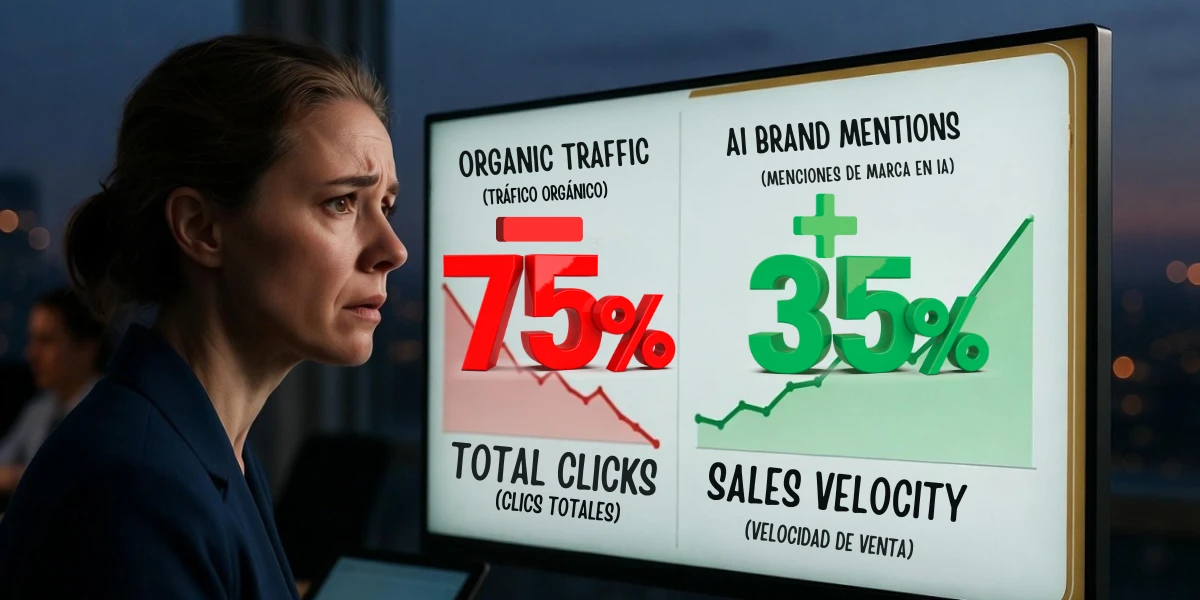
There is an uncomfortable conversation that plays out every week in meeting rooms around the world. The marketing lead presents the organic traffic report. The numbers are down. Someone asks why. And the honest answer gets avoided because it sounds like an excuse: search engines are answering users' questions directly, and those users no longer need to click through to any website to find what they came for.
There is a specific name for this in the industry: zero-click search. It happens when someone types a question into Google and the search engine displays the answer right there on the screen, without the user ever visiting a webpage.
Before AI-generated summaries became widespread, this only happened with very simple queries, like how many miles from London to Edinburgh or what the weather is like today in Manchester. Now it happens with far more complex questions: what is the best content strategy for a B2B company, what is the difference between a CRM and an ERP, or how does the sales funnel work in real estate.
Google synthesises, answers, and the user closes the tab. Your article, your time, and your budget served as raw material for the search engine, but the visit never came.
This is not an excuse for poor results. It is a structural shift that is already documented, with no clear signs of reverting in the near term, and one that is becoming increasingly visible across multiple sectors with a digital presence.
Ahrefs, February 2026: when Google displays an automatic summary, the top organic result receives more than half the clicks it did two years ago.
To understand the scale: if an article that used to receive a thousand visits a month from Google now receives fewer than five hundred with the same ranking, the cause is not that the article has gotten worse. It is that the search engine captured that audience before it ever arrived.
The Digital Bloom's aggregated report, published in October 2025, concludes that roughly six out of ten Google searches end without the user leaving the results page. For searches that trigger automatic summaries specifically, that figure rises to more than eight out of ten.
The first reaction from many businesses is to publish more content, hoping that volume will compensate for the drop in traffic per piece. It is the wrong response. Publishing generic articles at a faster pace in this environment is like opening more physical stores when e-commerce is destroying the market: more investment, same underlying problem left unsolved.
This article is not meant to alarm. It is meant to reorient. Because behind the drop in clicks there is a signal that almost nobody is reading correctly: some of the traffic that survives the zero-click filter arrives with a more commercially mature intent than before.
Less traffic, but better: the paradox that marketing reports keep missing
This is where the honest analysis gets complicated, and where most marketing reports stop short.
The dominant narrative is one of organic traffic collapse. And that narrative has real data behind it. According to the Seer Interactive report published in November 2025, which tracked the evolution of more than three thousand informational queries across 42 organisations over fifteen months, the click-through rate when an automatic summary appeared in the results fell from around two percent to less than one percent between June 2024 and September 2025.
The impact on paid ads was even sharper. And the most revealing finding in that study is that even queries without automatic summaries are losing clicks, by around forty percent, which suggests that something deeper is changing in how people decide whether to click at all.
At the same time, Microsoft Clarity published the results of an analysis in November 2025 covering more than 1,200 publisher and media sites. What they found turns the usual mental model completely upside down.
Traffic from conversational assistants like ChatGPT, Copilot, or Perplexity grew by more than 150% in eight months and converts at a rate three times higher than traditional channels. — Microsoft Clarity, November 2025
Users arriving from these tools were signing up or subscribing at rates between ten and twenty times higher than direct traffic or social traffic.
Ahrefs documented a similar pattern on their own site with data published in June 2025: AI-assisted search traffic represented less than one percent of total visits, but drove more than ten percent of sign-ups, converting at a rate twenty times higher than conventional organic search.
The Adobe Digital Economy Index, in its January 2026 report, confirmed the same trend in e-commerce: conversion rates from AI-referred traffic grew by more than fifty percent year-on-year, with conversions during Black Friday 2025 running nearly forty points above non-AI traffic.
Why it converts better: the pre-filtering effect
The underlying explanation is not hard to follow once you think about how the process actually works. When someone asks ChatGPT which project management software they should use for a ten-person team working remotely, the assistant returns a considered answer that has already filtered options, compared features, and ruled out alternatives.
If your product or company appears in that answer as a reference, the user who clicks through to your site has already gone through that selection process. They are not in the exploration phase. They are in the confirmation phase. It is the difference between the customer who walks into a shop to browse and the one who walks in because they have already decided to buy and just wants to see the product before signing.
Not everyone arrives ready to purchase, but many arrive after a process of filtering and comparison that used to happen inside your own website. The user coming from a conversational recommendation tends to enter at a stage much closer to validation than to discovery.
The paradox resolves itself in a concrete way: zero-click search does not kill marketing, it kills the marketing that was never converting to begin with. The low-intent informational traffic produced by articles of the what-is-this or how-does-that-work variety is no longer arriving. And that traffic was not buying, not signing up, not recommending anything to anyone either.
What remains tends to concentrate a greater proportion of the intent that actually matters to the business. That traffic has not disappeared: it has become more focused and more qualified.
The metrics that actually matter in 2026
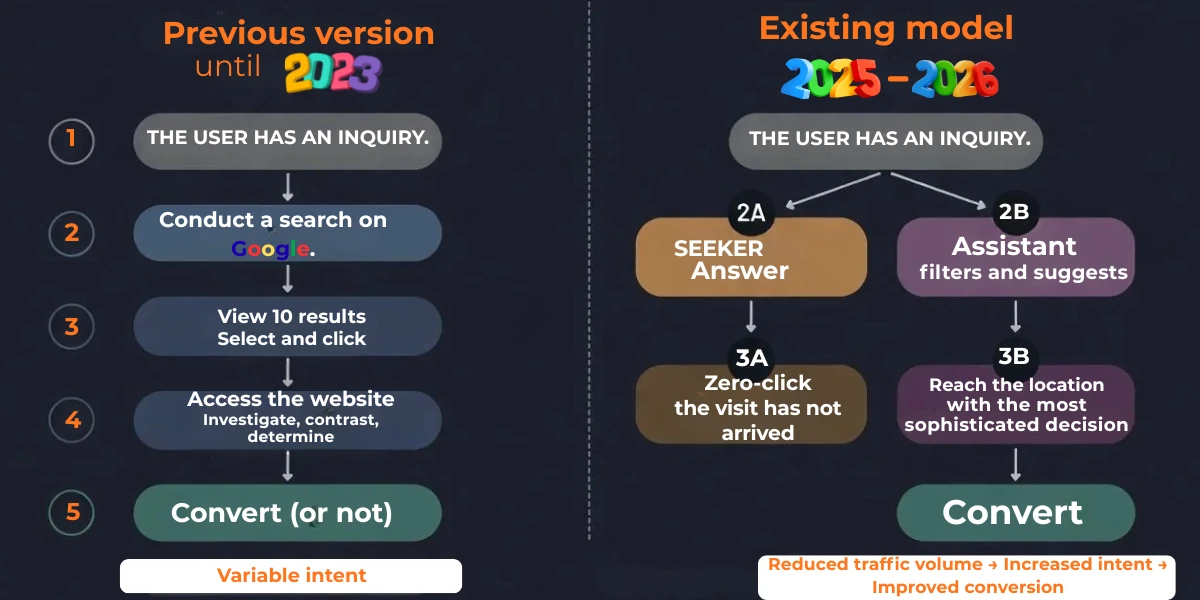
The user journey has changed structurally. In the old model, users arrived to explore. In the current model, when they arrive, they have already made most of the decision.
The problem is that most organisations are still measuring their digital success with instruments designed for the previous world. Total sessions, pageviews, time on site, average position in search results.
All of those metrics share the same structural flaw: they measure the volume of a flow that is shrinking, not the value of what is still flowing. It is like assessing the health of a business by counting how many people walk through the door instead of how many actually buy something.
A senior leader who sees a twenty or thirty percent drop in organic sessions and concludes that the content strategy has failed is making a decision based on misread data. The right question is not how many people arrived, but how many of the people who arrived did something that matters to the business.
Metric 1: brand visibility in AI search assistants
The practical question is this: when someone asks ChatGPT or Perplexity which company to use in your category, do you appear? Does your competitor? This is not an abstract concern: it is something you can track manually through regular testing, and dedicated tools and methodologies for monitoring it more systematically are beginning to emerge.
Ahrefs, 2025 — 75,000 brands analysed: YouTube presence appears as one of the signals most strongly correlated with brand visibility in AI-assisted search, ahead of many traditional web authority signals.
BrightEdge, in their July 2025 analysis, found that AI search assistants mention brands roughly three times more often than they cite them with a link. That means there is an enormous layer of brand visibility that never generates a trackable click but that directly influences purchasing decisions.
A customer might have encountered your company because ChatGPT mentioned it three times in different responses over the past month, typed your name directly into a browser, and shown up in your analytics as direct traffic with no apparent origin.
Metric 2: dark traffic
The name sounds technical but the concept is straightforward. It is all the traffic that arrives at your site without any analytics tool being able to identify where it came from.
Think about this: when someone shares a link in a private WhatsApp chat and another person clicks it, does Google Analytics know it came from that chat? It does not. It shows up as a direct visit, as though that person had typed your URL from memory. The same applies to private messages in Slack, chats in Discord, closed threads in Telegram, and increasingly, conversations inside the conversational assistants themselves.
Research by SparkToro showed the extent to which a significant portion of traffic from private channels ends up misclassified as direct in Google Analytics, invisible to any attribution analysis. Private channels account for a very significant share of the actual exchange of links and recommendations on the internet, and that proportion keeps growing as messaging apps become the primary communication channel.
If your direct traffic has been growing over recent months, it may not be because people are remembering your URL: your brand may be gaining recommendations in conversations that no conventional measurement system can see.
Metric 3: the speed of the sales cycle
This metric connects content to business outcomes more directly than any other: the time that passes between a prospective customer first making contact with your company and taking a purchase decision.
If your content is being cited as a reference by search systems, that customer arrives at your commercial process having already done most of the cognitive work. They already know what problem you solve, they have already compared alternatives, they already have formed expectations.
A company that measures this time before and after publishing authoritative content has a direct indicator of the commercial impact of its content strategy, without needing to rely on traffic as an intermediate metric.
Four moves you can make starting tomorrow
Before getting into tactics, it is worth establishing the real starting point. Data from Datos and SparkToro for the second quarter of 2025, based on the search behaviour of tens of millions of desktop users in the United States and Europe, shows that Google still holds around ninety-five percent of traditional search. Google is not dead. What has changed is the architecture of how attention is distributed within that search.
Move 1: answer the questions your competitors avoid
To understand the difference, consider two types of content. The first is an article titled what is a CRM and what is it used for. That article answers a question Google can already answer directly in the results without anyone visiting your site.
The second is an article that answers the question why CRMs fail in companies with fewer than twenty employees that do not have a dedicated sales manager. That second question has context, specificity, and friction. It requires someone with real experience to commit to an answer. Search engines cannot synthesise it without sources, and if you are the source, you appear in the response.
The uncomfortable questions that competitors avoid because they are hard to answer without taking a position are precisely the ones most likely today to generate authority-level visibility and attract the visitor who is already in the process of making a real decision.
Move 2: content that shows someone actually did the work
A study by researchers at Princeton, Georgia Tech, and the Allen Institute for AI presented at the ACM KDD conference in 2024 found that the tactic with the greatest impact on visibility in generative systems is not keyword density or article length.
The tactic that most increases visibility in generative systems is citing verifiable sources and including original data or concrete statistics. — Princeton / Georgia Tech / Allen Institute for AI, KDD 2024
The difference between a generic article and one that search systems cite as authoritative is usually not the topic but the evidence. An article that includes the results of your own survey of fifty clients, however modest the scale, is worth more in this environment than one that elegantly synthesises twenty third-party studies.
An interview with a real professional whose name and opinion are on the record is worth more than ten paragraphs of abstract analysis. The systems that decide what to cite do not distinguish between the size of the company that published the data: they distinguish between whether the data is original or derivative.
Move 3: distribute beyond the blog
The Ahrefs brand visibility analysis found that YouTube presence is the strongest predictor of visibility in conversational assistants, ahead of inbound links and media coverage. This makes sense when you consider how these systems were trained: YouTube is one of the richest and most diverse sources of human knowledge and opinion available on the internet.
Reddit, meanwhile, has moved from niche forum to front-and-centre position in Google's organic search visibility. Users go to Reddit precisely when they want real human perspectives, not branded content. A company that participates genuinely in relevant Reddit communities, answering questions with substance and without selling anything, builds the kind of visibility that does not appear in Google Analytics but that feeds both the search algorithm and the models behind conversational assistants.
Move 4: redesign the marketing team's primary metric
This is the hardest move because it is not technical but organisational. If the marketing team is still being evaluated on organic sessions and search rankings, it will make decisions optimised for those metrics even when those decisions are the wrong ones for the business.
It is the equivalent of measuring a sales team solely by the number of calls made, without looking at whether those calls generated any revenue.
Success in this environment is measured in visibility and share of voice, not in clicks and traffic. — Seer Interactive, November 2025
The conversation that needs to happen at the leadership level is about what actually measures the value of marketing now: the conversion rate of traffic from conversational assistants, the reduction of the sales cycle, the frequency with which the brand appears in AI responses about its category.
Be the source, not the destination
There is a way to reframe everything above that makes it more manageable for any team.
For decades, the goal of digital marketing was to be the final destination of the click. Appear in the top result, receive the visit, convert the user. The process started in a search engine and ended on your website. The metaphor was a road: the search engine was the map, and your site was the place people wanted to reach.
That metaphor no longer holds. Today the search engine is not the map: it is the guide who answers the question directly before the journey even begins. Users are not searching for the best marketing automation services and then choosing from ten results: they are asking an assistant directly what it recommends for their specific situation. The assistant synthesises, filters, recommends.
If your company has built the kind of content that these systems recognise as a verified authority in your field, you appear in that answer. If not, you do not exist in that conversation, regardless of your position in Google.
The goal is no longer to be the destination. It is to be the source that feeds the system making visibility decisions before the user has clicked on anything. Like a reference encyclopaedia that journalists consult before writing their articles: the encyclopaedia is rarely cited by name, but its influence is everywhere.
That requires fewer pieces designed to capture generic search traffic and more content that demonstrates real perspective, original data, and grounded opinion. Less obsession with publication volume and more attention to the depth and verifiability of each piece.
The decline in organic traffic is not the end of content marketing. It is the end of content marketing designed for algorithms. Content marketing designed for audiences who genuinely benefit from what you produce still works. And in the current environment it works better than before, because the background noise has been drastically reduced.
Volume without rigour was a tactic. Rigour without volume is a strategy.
The teams that understand this first will not have to wait for the market to catch up with them.
Sources
Source | Date | Link |
|---|---|---|
Ahrefs – AI Overviews Reduce Clicks by 58% | Feb. 2026 | |
Ahrefs – The Great Decoupling | Jun. 2025 | |
Ahrefs – Top Brand Visibility Factors (75k brands) | 2025 | |
Seer Interactive – AIO Impact on Google CTR | Nov. 2025 | |
Microsoft Clarity – AI Traffic Converts at 3x | Nov. 2025 | |
The Digital Bloom – 2025 Organic Traffic Crisis Report | Oct. 2025 | |
BrightEdge – ChatGPT Brand Mentions vs Citations | Jul. 2025 | |
Datos & SparkToro – State of Search Q2 2025 | Aug. 2025 | |
Adobe Digital Economy Index – ALM Corp | Jan. 2026 | |
CLICKVISION Digital – Zero Click Search Statistics 2026 | Mar. 2026 | |
Aggarwal et al. – GEO: Generative Engine Optimization (KDD 2024) | 2024 |
Related articles

ChatGPT Can Cost You a Sale Before the Click
Some sales are no longer lost on your website. ChatGPT can compare, reject and recommend before the click, leaving no visit, no abandoned cart and no trace in your dashboard.
How to turn your content into audio without setting up a studio
Turn any Studio article, social adaptation or free-editor text into natural audio. Own engine, curated voices, free samples and pay-per-word, right from the same button.
Answer Capsules: How to Structure Content So AI Can Cite It
Answer Capsules structure content so RAG systems can extract, cite and measure its impact on visibility, MQLs and pipeline when traditional attribution fails.
Found this useful? Share it with someone who needs it!