
ChatGPT Can Cost You a Sale Before the Click
 Lourdes 13 min read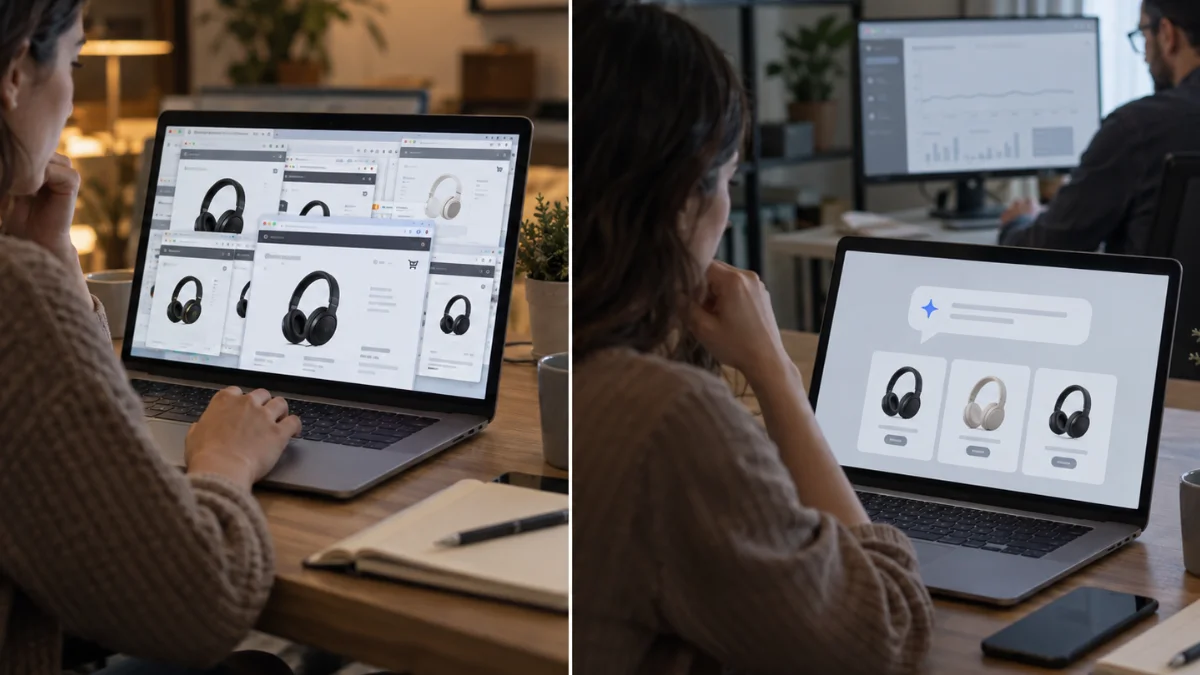
TL;DR. Since November 2025 you can lose a customer inside a ChatGPT conversation, without them ever landing on your site. Several shops get compared in there, one gets picked, and nobody tells the ones that didn't. It moves very little money so far. But it's exactly the slice of the sale that no counter of yours records.
When you lose a sale, you usually end up seeing it. There's the basket someone abandoned after typing in their address. Or the customer who came back three times to look at the same product and never bought it. It stings on a Monday morning, but at least you know that person was in your shop and where they backed out.
Since November 2025 there's a way of losing customers that doesn't leave you even that.
Before, someone after a pair of headphones typed best noise-cancelling headphones into Google and spent half an hour opening tabs. They compared on their own, and somewhere along the way they passed through your shop, even if only in passing.
Now they tell ChatGPT they're on video calls all day and want headphones that don't squeeze their ears. That isn't searching any more, it's describing a problem to somebody. And ChatGPT goes off and reads the product pages of several shops, takes a couple of minutes, and comes back with three or four models, the price of each and which one it would go for.
If your headphones aren't among those three or four, you've lost a sale and you won't find out. Nobody came into your shop. On Monday there's nothing to review.
You don't just lose the sale, you lose the explanation
You've had a bad month before and you take it on the chin. What's rough now is that three completely different things look identical on your screen. That the guy came in, saw you and went to another shop. That he looked for you and couldn't find you. And that he decided without ever knowing you existed. All three reach you as the same thing, one little line heading down.
The first two leave you something, however thin. A ten-second visit, a search, someone who opened a product and left. The third leaves you nothing at all.
And that's when the blind swinging starts. You drop the price on the off chance, you change the photos, you throw more money at ads, you switch agencies. Months of it, burning cash, without even knowing whether the problem was there.
Because what's broken isn't a traffic channel. It's that until now, when something went wrong, your numbers told you where to look. Now they leave you in the dark and charge you the same.
Why you and your neighbour get different lists
This is where a habit of years falls apart. On Google there's a ranking. You may not know how to climb it, but you know it exists and that somebody is sitting at the top. Here there's no ranking. The same question, asked by two people, comes back with two different answers.
OpenAI says so in its own documentation. To decide which products to show you it looks at two things: what you're asking and what it already knows about you. And what it knows about you includes memory, meaning everything you've told it over time, sometimes weeks ago and while talking about something else. The example is theirs: if you once said you don't like clowns, it may not show you clown costumes.
And it doesn't hand you a list of links to choose from. It hands you a verdict. With labels stuck on the photos, on the order of budget pick or most popular. Those labels are written by the model, and OpenAI itself warns they're not guarantees or verified claims. Budget pick can mean only that reviews mention good value for money. Not that it's the cheapest thing out there. Between ten blue links and a sentence telling you which one to buy there's a world of difference.
The backpack you had on the shelf
Somebody asks for a backpack that fits under an airline seat. You've got one. Right dimensions, in stock, good price. It picks others and yours doesn't come up.
There's going to be a zero in your numbers. And what really stings is that they may well have read you. They went into your page, took the measurements and the price, and decided another one was a better fit. They looked at you and ruled you out. Not so much as a goodbye.
You do see the other half, and that's worth saying. When it recommends you and the customer clicks, that visit lands on your site like any other and your numbers show where it came from. The tools that measure this have been separating it out since October 2024. So you see your wins. You see none of your losses. And with half the cards face down there's no way to tell whether you're ahead or being fleeced.
The shop window is gone
Something else goes along the way: the order in which you present yourself. When somebody arrived at your site, you were in charge. The photo they see first, the strongest point right at the top, the guarantee, next-day delivery, the FAQ sitting there to kill the doubt before it turned up. The drawbacks, if you mentioned them at all, came after the good part.
Now OpenAI says the guide covers the differences between products and the trade-offs of each one. Translated: the customer gets your drawbacks before they've read a single line of your pitch. They're told yours is heavier. And that's where it ends.
Reviews are stranger still. Out there you've got contradictory opinions, old ones, one written in a foul mood on a Tuesday afternoon. And all of it comes out as one clean sentence, along the lines of users agree the quality is good but after-sales service is slow. It sounds like a conclusion. It's a summary the model writes from reviews on public sites, and OpenAI states plainly that nobody on their side verifies the reviews or the ratings. The one-star for a late delivery in 2023 is going to outlive your company.
And then there's the price, which is a piece of work. The one shown first usually isn't the cheapest: it's the one from the shop sitting at the top of the list. They admit it themselves. They say that inside the product page they do try to put the lowest price they know about at the top, sometimes with a best price label on it. But part of this lands on you. If you drop a price today or change your delivery charges, it takes a while to show. And for that whole stretch you're being compared on your old price.
The forty coffee machines
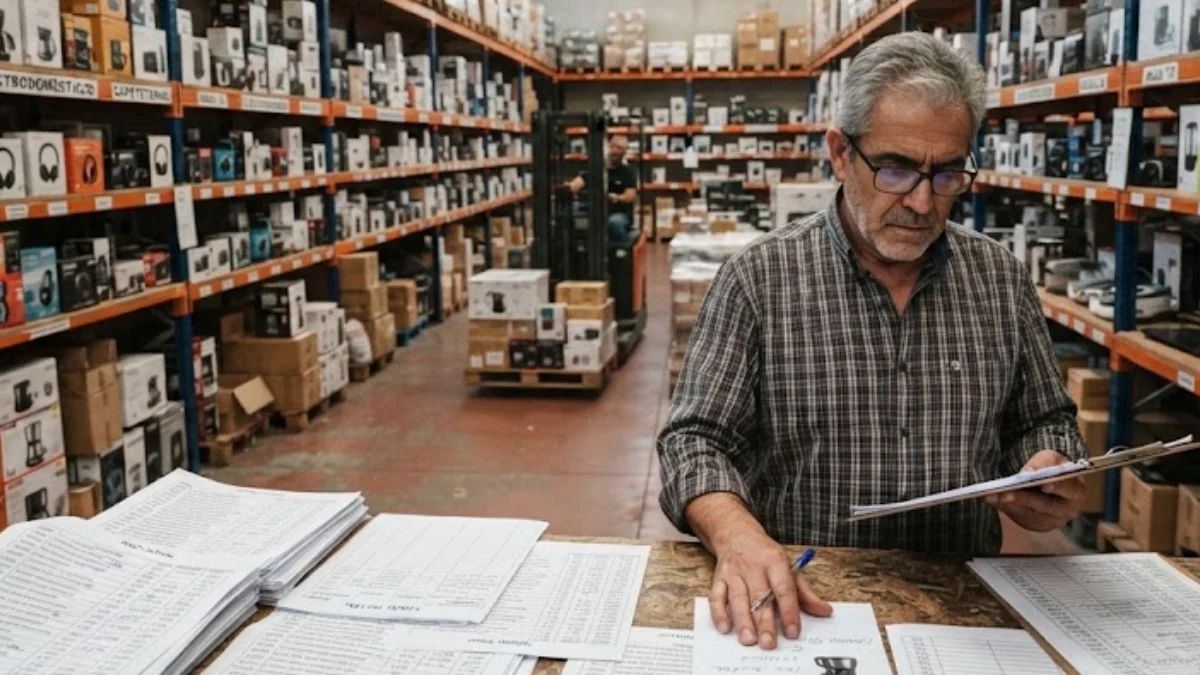
It's the shop-floor thing, but far bigger. You walk in to buy a coffee machine, there are forty in the aisle, and the assistant tells you he'd look at these three. The other thirty-seven are still there, same shelf, same price, the same specs they had a minute ago. But they've stopped existing for that purchase. Nobody pulled them, and not one of them gets a chance to make its case.
Except that the assistant in the shop has a face you can see. Nobody sees this one, not you and not the thirty-seven.
The click is no longer the beginning, it's the end
The old route was search, click, compare, decide. The customer did the comparing, and did it in your house. The new one is ask, get the options cut down, compare what's left and then click. The click isn't dead, it just arrives later. By the time that customer shows up on your site they're not there to discover anything, they're there to confirm.
And that forces you to read your numbers differently. What's going down no longer tells you what you've lost. That's another conversation, a longer one, and I've written it up separately.
None of this is me making things up to scare you. OpenAI says it themselves, selling the thing to merchants, and the phrase is theirs: attract high-intent shoppers, closer to making a decision. Read that again slowly. If the customer reaches you with the decision half made, the convincing happened somewhere else. And somebody else did that work, with your product pages and your reviews in front of them.
How big this really is
Before anyone panics, the size of it. Small.
It was measured between August 2024 and July 2025 by a professor at the Frankfurt School and a researcher at the University of Hamburg. They took 973 shops that together turn over twenty billion dollars. What came in from ChatGPT was a crumb of the total. It sold worse than every one of the traditional channels, with one exception: it beat paid social, both in visitors who ended up buying and in what each visit left behind. And this isn't a consultancy brochure. It came out in Marketing Science in April 2026, with other researchers reviewing it.
The interesting part of that work isn't the headline, it's the detail. The more complicated the product, the better that channel performs. On simple things it barely contributes. On the ones you have to compare, measure and rule out, it starts to be worth something. Which is exactly where the backpack, the headphones and the coffee machine live.
Then came another measurement, from a company that sells analytics software, run on shops in the United States. It says that small trickle of traffic has turned into high quality and buys considerably more than the rest. Both can be true, because they're looking at different months and different places. Which of the two describes what's coming, no idea.
What neither of them measures is your side of it. Both are counting the ones who arrived.
What you can do, and what they'll try to sell you
With all that in front of you, there isn't much to do. But the little there is, is yours.
Make your product pages tell the truth and tell all of it. Price, dimensions, what it's for and what it isn't for. And stock kept current. That's what's being read, and when a detail is missing there's nobody there to fill it in your favour.
Then, a three-line question to whoever runs your site. Whether your site is blocking OpenAI's crawlers, and whether the security service you're paying for lets them through. Those crawlers have names and they're documented, so it's a yes or a no and it takes five minutes to check.
With one warning. One of those crawlers is the one that shows up when a user asks something, and about that one OpenAI no longer says it respects the file that keeps it out. So opening the door is more reliable than closing it.
And there's more published than usually gets told. To decide which product comes up, OpenAI says it can weigh price, reviews, availability and how easy something is to use. And that the weight of each changes with what you ask: if you say what you want to spend, it looks mostly at price. To rank shops when several sell the same thing, it says it looks at whether you have it in stock, at what price, at what quality, and whether you're the one who makes it or sells it first-hand. That leaves you three things you're in charge of: having stock, not being expensive and being the maker.
The two lists are separate, and OpenAI keeps them separate. One is which products come up. The other is, once the product is chosen, which shop they send you to for it.
And there's a detail that shows how fast this moves. In the September 2025 announcement, having in-chat checkout switched on was listed among the things they look at when ranking shops. In the current documentation it's gone. And the old announcement is still up exactly as it was, so depending on which OpenAI page you read, that button counts or it doesn't.
What isn't published anywhere is the full recipe or any ranking formula. So the day somebody calls promising you the top of the list, with their method and their neatly ordered factors, that part they're inventing in front of you. And they're going to bill you for it. A frightened shop owner who can't check anything is the best customer there is.
Buying a place inside the product list, today, isn't possible. Buying an ad is. On 9 February 2026 ChatGPT started testing advertising in the United States, on free accounts and the Go plan, with an ads manager they're opening country by country. The ad sits below the answer, marked as sponsored and kept apart from the product results. The order is decided between how well it matches your question and what the advertiser bids. The same road Google went down, in case it caught anyone by surprise.
Even the payment isn't safely yours
In March 2026 OpenAI stopped pushing payment inside the chat and moved its weight to the deciding part. Their official version is that the first way of paying didn't give them the flexibility they wanted. Mine is that not many people fancy putting their card details inside a conversation, and no new version fixes that. They didn't bury it, though: their current documentation says that for some products and some merchants the buy button still shows up without leaving the chat.
So even the payment isn't certain to stay in your house. The choosing certainly doesn't. And losing a sale today no longer requires anybody to visit your site.
Frequently asked questions
My shop runs on Shopify, does it affect me the same?
Worse: you're already in. OpenAI says products from Shopify shops come into ChatGPT through the Shopify catalogue, and it puts it in these words, that no additional work is required from merchants. Which means you've been competing in there for months without asking to and without anybody telling you. What gets read about you is whatever is on your product pages. Exactly as they stand today.
Can I check whether I come up or not?
By asking it, no. What it answers you doesn't count, because it factors in what it already knows about you, and the same question from two people returns two different lists. You can try from a session without your account and get a rough idea, but that's what it is, a rough idea. There's nowhere to go and look up your position, because there is no position. And that's precisely the part that doesn't get fixed.
Is this only ChatGPT?
No, and here's the part almost nobody mentions. Google presented its own on 11 January 2026, a standard for buying through AI agents built with Shopify, Etsy, Wayfair, Target and Walmart, meant for its AI answers and for Gemini. Both of the big houses are heading for the same place, which is to sit in the moment when the customer is still deciding. Before your site. Before you.
Sources
Source | Date | Link |
|---|---|---|
Shopping with ChatGPT Search, OpenAI help centre. Memory, the labels, the review summaries, the first merchant's price, the product and merchant criteria, and the buy button that's still alive | Updated Aug 2026 | |
Introducing shopping research in ChatGPT, OpenAI. The launch and how the feature works | 24 Nov 2025 | |
Driving product discovery in ChatGPT, OpenAI. The Shopify catalogue, the high-intent shoppers line and the retreat from in-chat payment | 24 Mar 2026 | |
Ads in ChatGPT, OpenAI help centre. The 9 February 2026 advertising and how it's ordered | Updated Sep 2026 | |
Buy it in ChatGPT, OpenAI. In-chat payment, and the button as a merchant criterion in the 2025 version | 29 Sep 2025 | |
Overview of OpenAI Crawlers, OpenAI developer documentation. The named crawlers and the file that shuts them out or lets them in | Current | |
Kaiser, M. and Schulze, C. ChatGPT Referrals to E-Commerce Websites, Marketing Science, vol. 45 no. 4, pp. 699-715. The 973 shops and the result by channel | Apr 2026 | |
Adobe: AI-referred traffic to retail sites doubles in a year, Digital Commerce 360 with Adobe data. The other measurement, on US retailers | 17 Jun 2026 | |
OpenAI's plans to make ChatGPT more like Amazon aren't going so well, TechCrunch. An OpenAI spokesperson confirming the March shift | 24 Mar 2026 | |
Google announces a new protocol to facilitate commerce using AI agents, TechCrunch. Google's standard and its partners | 11 Jan 2026 |
Related articles
How to turn your content into audio without setting up a studio
Turn any Studio article, social adaptation or free-editor text into natural audio. Own engine, curated voices, free samples and pay-per-word, right from the same button.
Answer Capsules: How to Structure Content So AI Can Cite It
Answer Capsules structure content so RAG systems can extract, cite and measure its impact on visibility, MQLs and pipeline when traditional attribution fails.

Don't publish every day. Build a system
Publishing daily out of fear of vanishing burns you out, blurs your brand and fills your channels with noise. The way out is a system: a few good ideas, one base piece a week and channel adaptation.
Found this useful? Share it with someone who needs it!