
Don't publish every day. Build a system
 Studio31 min read
TL;DR-Publishing every day out of fear of vanishing burns you out and blurs your brand. What works isn't volume, it's system: four or five pillars, one base piece a week, channel adaptation and two or three signals per goal. A few good ideas worked properly beat five loose pieces made to fill a calendar.
Publishing every single day has turned into an obligation nobody really understood. You've got a small business, your own project, a personal brand or a digital product, and you've heard the same recipe a thousand times: you have to be on LinkedIn, on Instagram, on X, on TikTok, on YouTube, on the blog, in the newsletter, and now wedged into the AI answers too. Said from the outside it sounds easy. It changes the second you're the one writing, reviewing, adapting, publishing, replying, measuring, and still running the actual business on top of all that.
You didn't make the fear up. The content pressure is real and it shows in the numbers. Adobe asked more than 1,600 marketing professionals and 96% said content demand had at least doubled in two years, 62% were talking about five times or more, and 71% expect it to multiply by five again before 2027. This isn't a bad-day feeling. The market wants more pieces, more formats, more channels, more versions, and faster.
And you see it in ordinary stuff. A freelancer hangs up the phone with a client and already knows that question should be a post. A shop sets up a promo and suddenly needs web copy, an Instagram post, a customer email, an image, a story, a WhatsApp message and maybe a video. An agency gets a report and has to pull an article, a summary, a carousel, a newsletter and a sales proposal out of it. The work isn't just writing, it's turning one idea into useful pieces without breaking yourself in the process.
There's the trap. When the pressure climbs, the easy move is to produce more: more articles, more posts, more videos, more versions, more automation, more tools. But producing more without a system fixes nothing, it speeds the problem up. If it used to take you a morning to crank out a weak piece, now you can crank out five weak pieces in an hour. AI has dropped the cost of the first draft through the floor, but it hasn't touched the work that matters: deciding what deserves to go out, for whom, with what goal, in what format, with what review, and how you'll know whether it did anything.
This article isn't about publishing less out of laziness, it's about not publishing out of fear. Publishing little and with no intention fixes nothing either. But publishing every day because you think going quiet wipes you off the map burns you out, blurs your brand and fills your channels with pieces that do nothing. The way out isn't disappearing, it's building a system you can actually sustain without turning every week into a chase.
The half-truth of publishing every day
Publishing every day can work, and denying it would be silly. There are creators, media outlets, brands with teams and companies with resources that can hold a daily piece, or several. On some channels, especially the fast ones, frequency matters. Buffer, in its 2026 guide, recommends different rhythms per platform: several times a week on Instagram, TikTok and LinkedIn, more on X, something else on YouTube and Pinterest. The takeaway isn't that there's a magic number, it's that every channel asks for its own thing, and that consistency counts.
The problem starts when a small business copies a big structure's frequency without copying the team, the budget or the process. A brand with a content department has a strategist, a copywriter, a designer, a video editor, a community manager, an analyst and someone signing off on pieces. You, or your team of three, do all of that between clients, product, sales, support, invoices, meetings and whatever caught fire that morning. Try to publish at a full factory's pace and you end up confusing presence with survival.
A case you see all the time. A neighborhood café notices other accounts dropping reels every day and jumps in. Week one it films coffees, tables, breakfasts, customers walking in, offers, loose one-liners. Week two it's out of things to say, week three it's repeating the same shots, and week four it stops, because tending the counter was more urgent. The mistake wasn't publishing too little. It was starting with frequency, with no pillars, no formats it could sustain, and no clear reason for each piece.
Another case like it. A B2B consultant forces himself to post every day on LinkedIn. At first he shares useful stuff, but then he starts commenting on any old news, recycling generic lines, weighing in on things that have nothing to do with what he sells. He's active, but he's building nothing in the head of whoever reads him. The presence is there, and still the brand goes fuzzy.
Frequency isn't the strategy, it's one variable inside it. Daily publishing works if every piece does a job, and it's noise if every post is born from the obligation to fill a calendar. The person reading you doesn't notice your effort; they notice whether it helps, whether it makes sense, or whether you're wearing them out. A brand that publishes a lot but always says the same thing in different words becomes wallpaper. It's there, but nobody cares anymore.
That's why the first shift happens on the inside. You don't have to win on volume if you can't sustain the volume, you have to win on system. That means knowing what topics you touch, what problems you solve, what formats you can hold, what you can reuse, and what you'll look at to decide whether to keep going, fix things, or stop.
The real fear. If I don't publish, I vanish
The fear of vanishing makes sense. The platforms reward whoever keeps moving, competitors publish, the tools show you calendars stuffed to the brim, and the gurus keep repeating that consistency is everything. And meanwhile, the person running the business feels that easing off the pace means letting the market go.
That fear bites harder because the channels aren't four anymore. A business used to think blog, newsletter and one main network, and that was enough. Now content gets spread across search engines, social, short video, long video, communities, newsletters, product pages, comparison sites, generative answers, sales messages and support. HubSpot puts blogs among the formats marketers plan to invest in for 2026, but it also drops short video, live video, long video and user-generated content right in there. The practical bit is clear: a single piece doesn't stay in a single place anymore.
A Monday scene sums it up. It's nine in the morning and you've got an idea for an article. That idea works for the blog, but also for LinkedIn, for a newsletter, for a short script, for an FAQ page and for a sales reply. Without a system, the idea dies in a phone note or turns into a quick post that's gone in four hours. With a system, that same idea works for days or weeks.
The fear isn't only publishing, it's adapting. What works in an article doesn't work the same on LinkedIn, the LinkedIn version doesn't transfer straight to a newsletter, and the newsletter doesn't just become a video script. What blew up on one network can die on another if you copy it without changing rhythm, context and goal. The pressure doesn't come from writing once, it comes from turning the same idea into several pieces without it looking like a chain of mindless recycling.
This is where AI helps, but it can also make things worse. HubSpot says 94% of marketers plan to use AI in content creation in 2026, and that 80% already use it to write. So AI isn't a novelty anymore, and that means something else: using it no longer sets you apart from anyone. If everybody can pull a draft, the difference moves to judgment, context, editing, distribution and measurement.
There's one HubSpot figure worth looking at dead on. 83% of marketers say that with AI's arrival they're expected to produce more than ever. Read that slowly. The tool that was going to take work off your plate has ended up making people ask for more, and that's the hole. It's not that AI frees you, it's that it raises the bar for everyone and you run to keep up.
A small business doesn't have to fight on raw volume against whoever has more hands. It has to take its few strong ideas and turn them into several useful pieces, without starting from scratch every time and without losing its voice along the way.
AI doesn't take the work away if there's no system
One of the most common mistakes is believing AI replaces the process. It doesn't. It speeds parts of it up, fine, but it also creates new work if you use it badly. Glean's Work AI Index 2026 puts a number on a very specific load: workers spend an average of 6.4 hours a week supervising AI, feeding it context, checking what it puts out, fixing errors and cleaning up. Almost a full working day, every week. The report calls it botsitting, babysitting the machine.
That figure lands square on content, and anyone who's used AI seriously knows it. A bad instruction generates text you have to tear apart. Text with no context sounds like anybody, an automatic adaptation changes the meaning without telling you, a summary kills off the nuance that mattered, and a piece for social comes out identical to half the world's. And a badly verified claim ends up published with a straight face, dead sure of itself, and wrong.
It happens in ordinary jobs. You ask AI for a post about your shop's promo and it hands you something correct, identical to any other shop's. You ask for a customer newsletter and it slips in enthusiastic lines you'd never sign your name to. You give it a technical explanation and it softens it so much it loses precision. You give it a long article and it pulls three posts that repeat the same line in different wrapping. The tool has produced, but you're still the one fixing.
AI doesn't save you judgment, it demands it. If you're not clear on what you want to say, for whom, in what tone, from what source and toward what goal, AI fills the gaps with whatever's most probable. It looks correct, but it doesn't have to serve your brand. Speed with no direction just grows the pile of things you have to review.
Content Marketing Institute caught a very useful contradiction in its 2026 report. Among those using AI for content creation, most report gains in productivity and efficiency, but ask about quality and performance and the jump shrinks. Plainly put: AI helps you produce, but producing more doesn't guarantee the content works better. This confirms what a lot of people already feel in their gut. The bottleneck has moved. It used to be hard to get a draft out, now the hard part is deciding what to do with so many drafts.
The problem isn't running out of ideas, it's having no pillars
Plenty of people think their problem is not having ideas. Wrong. Most of the time they have too many loose ideas and nowhere to sort them. A client asked an interesting question, a competitor posted something debatable, there was industry news, an internal bug got fixed, a new feature shipped, a recurring question popped up in support. All of that is content, but with no framework it stays as scattered notes nobody looks at again.
An easy example. Someone emails you asking how long delivery takes, what a service includes, or why your tool costs more than another. That question can die in a private reply, or it can become an FAQ section, a short post, a newsletter explainer, a chunk for a landing page and a sales piece for future conversations. The difference isn't in the question, it's in having a system that spots there's gold sitting right there.
Another example. Your product fails at something, you fix it and you learn a lesson. Hide it and it stays in internal maintenance. Tell it carefully and it becomes trust-building content: what failed, how you caught it, what you changed and what the user should watch for. You don't have to make a drama out of every error, but plenty of ordinary operations carry real content inside them, far more useful than a generic list of tips.
A minimum system needs pillars, and they don't have to be twenty. Better if they aren't. For a small business, four or five do the job. An educational pillar, to explain the customer's problems. A proof pillar, to show cases, data, processes or lessons. An opinion pillar, to make a stance toward the market clear. A commercial pillar, to explain product, service, use or difference. And, if it fits, a current-affairs pillar, to comment on changes that matter in your sector.
These pillars save you from two extremes. The first, publishing only educational stuff and never selling. The second, publishing only sales and wearing everyone out. A healthy system mixes usefulness, judgment, proof and conversion. Not every piece has to sell, but every piece has to do something. If it doesn't educate, clarify, prove, answer an objection, build trust, spread an idea or help convert, maybe it didn't need publishing.
The raw material for all this still comes from you: your experience, your real doubts, your clients, your mistakes, your cases, your data and your stances. A tool will help you shape it, but it won't tell you what your business is, what you stand for or what problem you solve. That part's on you.
One base piece beats five bright ideas
Improvised content wears you down because every post seems to start from zero. Today you have to think up a post, tomorrow another, the day after another, then a newsletter, then a video, then adapt it for LinkedIn. If every piece is born from a blank page, the system blows up fast.
The alternative is working with a base piece. A base piece can be an article, a guide, a long answer to an objection, a technical explanation, a comparison, a customer experience, a product reflection or the breakdown of a news item. It doesn't have to come out perfect, it has to have enough meat to feed several outputs.
Think of a firm wanting to explain a tax change. It can drop a quick note on social and forget it, or it can build a base piece: what changes, who it affects, what date matters, what the client should review and what mistakes to dodge. Out of that piece come a customer newsletter, a LinkedIn post, an FAQ for the website, a short script and a sales message for anyone who asks for info. The upfront effort is bigger than writing a loose post, but the return on the idea is much higher.
Same with an online shop drowning in sizing questions every day. It can answer one by one until the end of time, or it can build a sizing guide with examples, turn it into a carousel, stick it on the product page, sum it up in an email and use it in support. The base piece doesn't just generate content, it takes future work off your plate.
A base piece spins off several derivatives. An article becomes a LinkedIn post built around the thesis, generates a newsletter with more context and a more direct close, gives you three short posts, turns into a one-minute video script, becomes an FAQ section, feeds a sales page if it answers a buying objection, and gives you a short audio if your product lets you turn text into voice.
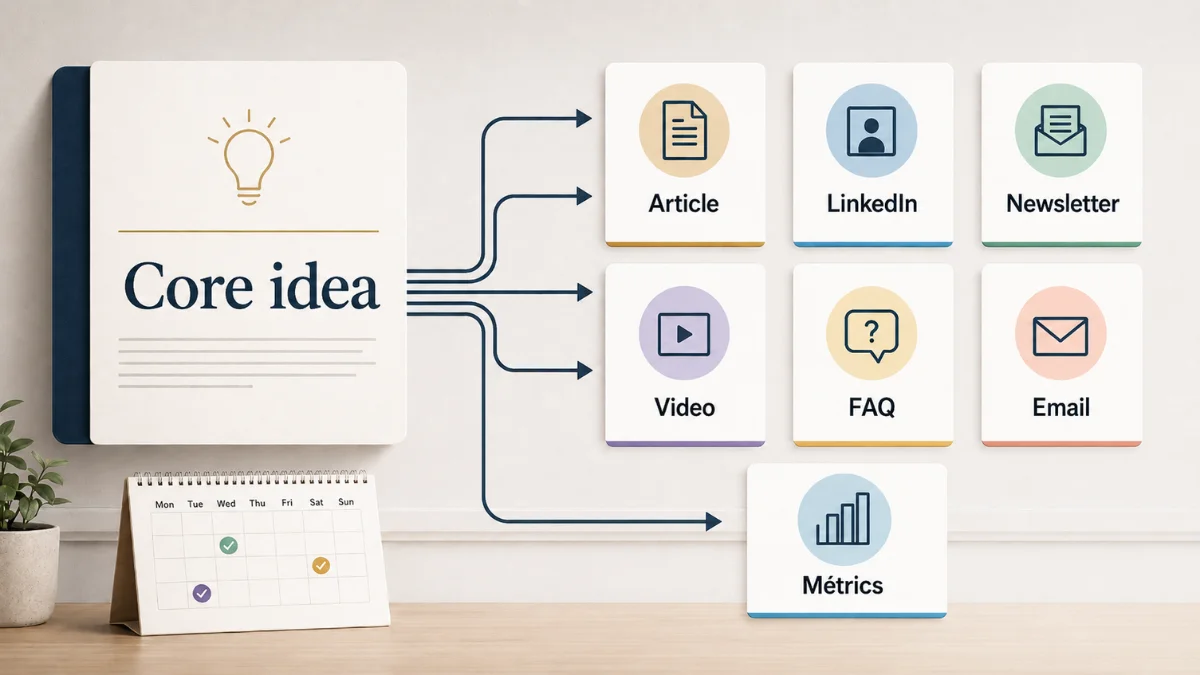
This isn't duplicating content, it's adapting the same idea to different consumption situations. Someone reading an article isn't in the same mode as someone watching a short video, and the newsletter subscriber expects something different from the person landing from a social feed. Reusing well isn't copy and paste, it's taking the thesis, changing the format, adjusting the rhythm and not losing the coherence.
And there's the real answer to the fear of not reaching people. You don't need to invent ten ideas a week, you work one or two strong ideas and you squeeze them properly. The goal isn't to look like you're everywhere, it's for each idea to do more work before you let it go. Publishing fewer pieces isn't communicating less, it's communicating with more sense.
Presence isn't built on quantity alone, it's also built on smart repetition. Repeating an important idea isn't bad if you adapt it well. In fact, plenty of brands fail at the opposite: they say something once and assume the market already got it. The audience doesn't follow every post, not everyone reads everything, not everyone arrives by the same door. A system lets you repeat without copying yourself, insist without saturating, and reinforce your position without sounding like a robot.
You see it clearly in any complex sale. If your client always hesitates on price, that objection doesn't fall with a single post, you work it from several angles: a real-cost comparison, a case study, a process explanation, an FAQ page, a piece on what buying cheap ends up costing, and a short sales reply for private conversations. You're not repeating for the sake of it, you're hitting the same objection from different sides.
Publishing every day without a system usually gives the opposite: lots of pieces that build no memory. Today you talk about one thing, tomorrow another, the day after a trend, then a generic tip, then a motivational-calendar line. After a month you've got activity, but no position. Whoever follows you has seen movement, but they don't know exactly what you do, why they should trust you, or what problem you solve better than others.
The fear of sounding like cheap AI
There's another fear getting sharper by the day: using AI and having it show in a bad way. Not because everything AI-assisted is bad, but because a lot of what gets published with AI sounds flat, interchangeable and with no experience behind it. Hootsuite notes in its 2026 trends that consumers stay wary of AI-generated content and ads, and that authenticity works as a differentiator. Nearly a third say they're less likely to choose a brand if they know its ads are made with AI. Klaviyo shows a half-built trust: only 13% of consumers say they fully trust AI, even though weekly use already hits 60% in its study of nearly 8,000 people.
The data matters because it dodges two errors. The first would be saying people reject AI, and it's false, because they use it: they fold it into searches, decisions, purchases and daily tasks. The second would be saying the user doesn't care, and that's false too. Trust depends on context, on how good the experience is, and on whether the brand keeps a recognizable judgment.
You notice it right away in everyday copy. A clinic publishes a generated post about dental care and ends up saying the same thing as any health website: general tips, friendly tone, predictable lines, zero sign of its own experience. But if it starts from real patient questions, drops in the mistakes it sees daily, explains the limits and reviews the text with professional judgment, AI helps without erasing the clinic's voice. The difference is in the input material and the review. Left to run on its own, the machine gives you the predictable.
Same in marketing. A brand asks AI for five ideas for social and gets correct lines, but with no edge. Publish that as-is and you're one more account. Use those ideas as a draft, cut the generic, add a real situation, drop in a customer objection and tune the tone to the channel, and the piece works. AI wasn't the main problem, the problem was publishing without editing.
And here's a figure that's a little dizzying. Glean reports that 69% of AI users admit to having shipped work they hadn't verified, didn't fully understand, or couldn't defend if asked. They've got another ugly word for it, botshitting: putting out whatever the machine spits without having looked at it. In an internal email that costs you a moment, but in public content it costs you your face. A brand doesn't publish just words, it publishes judgment, and judgment doesn't get handed off to an autocomplete.
The lesson is simple. AI works behind, the brand has to keep a voice in front. That means cutting empty lines, adding real examples, checking claims, using data when it's needed, trimming filler, and publishing nothing you don't understand. The final control belongs to whoever signs it. Full stop.
Measurement can be simpler too
Another source of exhaustion is measuring everything without knowing what any of it means. Impressions, reach, clicks, time on page, comments, saves, followers, subscribers, leads, conversions, cost per acquisition, brand searches, private replies, assisted sales. The list grows until it's useless for a small business.
Content Marketing Institute confirms that measuring whether content works is still a headache. HubSpot notes that marketers look at things like lead quality, conversion, return, acquisition cost and lead volume. That makes sense in teams with mature analytics, but a small business needs to start with something simpler: each piece, one job and one minimum signal.
If the piece is after visibility, look at reach, impressions, brand searches or traffic. If it's after interest, look at clicks, saves, time or replies. If it's after trust, look at useful comments, subscriptions, mentions or conversations that open up. If it's after business, look at leads, forms, sales, demos or sales replies. If it's after reuse, look at how many derivatives it generated and whether those derivatives served in other channels.
A case. You publish a long guide and the first week it gets four visits. That's not a failure on its own. If you then use it to answer five emails, pull two posts, link it from a landing page and get client doubts off your back, the piece has worked. Another case. A social post gets big reach but generates not one click, not one conversation, not one sales signal. It was visible, but it wasn't useful for your goal. Visible and useful aren't the same thing.
The key is not measuring every piece with the same stick. An educational article isn't judged like a direct-sales landing, an opinion post isn't measured on clicks alone, a newsletter can be worth it for the replies even if it brings no public traffic, and a video script can be useful even if it doesn't sell today, if it explains an objection that comes up again and again.
A content system lowers the anxiety because it stops you staring at numbers with no context. Before publishing you decide what the piece exists for, and then you look at a signal that matches that purpose. If it worked, you reuse it or scale it. If it didn't, you review topic, format, channel or distribution. And if you can't draw any conclusion at all, maybe the piece had no real goal from the start.
How to build a minimum system
A minimum system doesn't have to be complicated. In fact, if it's complicated you won't keep it up. Most small businesses, personal brands or digital projects need something basic but steady: pillars, idea bank, base piece, adaptation, calendar and measurement. The pillars you've already got from before, those four or five rails that keep you from publishing at random. With those locked, what's left is the how, so let's go in order.
Build an idea bank
The first thing after the pillars is the idea bank. Don't wait for inspiration, it never shows when you call it. The best ideas come out of the daily operation: client questions, support doubts, common mistakes, product changes, comparisons, industry news, sales conversations, recurring objections and problems you know how to solve. Save five real ideas a week and the problem stops being inventing and becomes choosing, which is a far better problem to have.
And that bank can be something very simple and functional. A note with the questions you've been asked. A document with objections. A folder with screenshots of problems you've solved. A list of mistakes you see in new clients. A log of improvements. You don't need a newsroom set up, you need to stop losing material that's already in front of you every day.
Pick one base piece a week
Then you pick a base piece. Don't try to turn every idea into a campaign, pick one or two a week and work them properly. It can be an article, but also a guide, a long answer, a comparison or an explainer. The only thing that matters is that it has enough structure to spin off other pieces.
Adapt by channel, don't copy and paste
Then you adapt by channel, which isn't copying the same piece everywhere but translating the intention to the format. LinkedIn carries the thesis with professional context, the newsletter a more explained version, X fragments or short ideas, video a problem with its explanation and its way out, the blog keeps the depth and the landing turns what you learned into a sales argument. Each channel asks for a version built for its use, not a carbon copy.
Measure little but well
And finally you measure little but well. Look at twenty metrics a week and you'll end up swamped. Look at two or three signals per goal and you'll learn. You don't need a huge dashboard to start, you need to know which pieces generated conversation, which brought traffic, which helped sell and which you can reuse.
A real week, not a brochure one
A sustainable week is much simpler than a stuffed calendar. Monday you review the idea bank and pick a base piece. Tuesday you build structure and draft. Wednesday you edit and publish the main piece, or leave it ready. Thursday you adapt it to a network or the newsletter. Friday you look at the basic signals and save what you learned for next week. Five days, one move per day.
Picture a company selling management software for small shops. Monday it spots a recurring question: how to keep stock under control without checking spreadsheets every morning. Tuesday it turns that question into a practical article. Wednesday it publishes it on the blog. Thursday it transforms it into a LinkedIn post for business owners and a short email for the users it already has. Friday it checks whether there were clicks, replies or any demo request. It hasn't published five new pieces from scratch, it's moved one idea, with its head on, through the whole flow.
Another example. An online shop gets hit with returns because people pick the wrong size. The base piece is a sizing guide, and out of it come a product-page section, a post-purchase email, a social post, a support reply and a short video script. The same idea cuts doubts, improves the experience and generates content. That's a fair bit more useful than publishing five generic fashion tips nobody reads.
This model isn't a universal law. A corner shop, a consultant, a SaaS tool and an agency don't run the same cadence. But the principle holds: working in blocks takes away the chase feeling. You're not thinking up what to publish from scratch every morning, you're moving an idea through a flow you've already built.
And this is the point where a tool like Studio actually fits, if you use it with judgment. It helps you go from idea to structure, from structure to draft, from draft to variations, from article to social post, from long text to shorter pieces, and it helps keep coherence across formats. What it shouldn't do is skip the review, because the review is exactly what stops AI turning your brand into a generic voice. A reasonable use would go like this: you define the piece's intention, prep a brief with audience, problem, angle and goal, generate a structure, review it, generate the draft, cut filler, add your own examples, verify the data, adapt to one or two channels, publish, measure and save what you learned. That process isn't slower than improvising, it's cleaner, and over the medium term it saves you time because each piece leaves reusable material behind.
Not every channel deserves the same effort
Another one to swallow: you don't have to be on every channel at the same intensity. The fear of vanishing multiplies when you try to cover everything at once. But not every business needs TikTok, or X, or a weekly newsletter, or long video, or five LinkedIn posts a week. The good question isn't where should I be because others are, it's where your client is, what format you can sustain, and which channel pushes your goal.
If you sell complex services, maybe LinkedIn, blog and newsletter pay off more than chasing every short format that comes along. If you've got a visual product, maybe Instagram, short video and case studies carry more weight. If you've got a technical tool, the documentation, comparisons, guides and articles serve you better than dropping lines daily. If you've got a community, the conversation matters more than reach.
A local academy gets more out of a good monthly newsletter, an FAQ guide and a handful of real cases than out of trying to film daily videos with no resources. A tool for developers needs clear documentation, examples, a changelog, technical articles and comparisons before light content across every network. A food brand needs image, recipe, season and closeness. The system answers to your business, not the calendar of whoever's next door.
Choosing channels is also an operational-health decision. A badly tended channel drains your energy and gives you little back. A well-worked channel feeds the others: an article feeds social, a newsletter tests ideas for future posts, a support question becomes educational content, a demo becomes a script, a real case becomes commercial proof. The system doesn't push you to do everything, it helps you decide what not to do yet. That's strategy too.
Publishing every day can be a sign of mess
There's an uncomfortable line plenty of brands should swallow: sometimes publishing every day doesn't show discipline, it shows anxiety. If every post is born from the fear of vanishing, content starts losing intention. You publish because it's time, not because it's needed. You force an opinion, you recycle a trend, you comment on something that adds nothing, you generate a piece identical to the last ones, and that gets called consistency.
Useful consistency isn't talking all the time, it's showing up in a recognizable way, with ideas that fit your brand and problems your audience understands. A business that publishes three times a week with clarity builds more trust than one publishing daily with no direction. Not always, but often.
Saturation has an internal cost too. Every piece demands attention, and even if AI generates it, somebody has to request it, review it, adjust it, publish it and watch it. With no system, content becomes a task that never ends, and a task that never ends starts fighting with what actually keeps the business standing.
You see it a lot in small businesses. The owner publishes at night because the day goes to clients. The marketing person opens the AI tool to pull something quick because there was no time to think. The freelancer promises the client more posts than they can review well. The agency takes on more formats with less budget. In all those cases content stops being a tool and becomes a weekly debt. That's why the goal isn't filling the calendar, it's building a small but useful machine: a few good ideas, good judgment, smart adaptation, simple measurement, reuse, review and a pace you can actually hold.
If you're already burned out
If you're already burned out on content, don't add another channel this week. Stop and take inventory. Look at what you've published over the last three months, separate the pieces that got useful signals from the ones that just filled space, look at which topics repeat, look at which client questions keep showing up, and look at whether you've got articles that could turn into a newsletter, posts or scripts. Hunt for content you already made and left half-squeezed.
Then cut back. Two main channels and one secondary, three or four pillars, one base piece, and you adapt it. Don't try to fix six months of mess in a week, it can't be done. The system starts the day you stop treating every post like an emergency.
A realistic example. If you've got ten old articles on the blog, maybe you don't need to write another ten. First check which ones still hold up. Update two. Pull three posts out of each. Turn one into a newsletter. Add an FAQ to the site. Build a short script from the article that best answers an objection. In a week you'll have generated more usefulness from what you already had than from writing another piece from scratch, and you'll have worked half as hard.
To close
Publishing every day isn't a universal obligation. It serves some teams and some channels, but it also turns into an absurd treadmill for small businesses, independent professionals and projects with no production structure behind them. Content pressure is climbing, AI has wedged itself into nearly every marketing flow, and users still expect human signals, usefulness and trust. That mix calls for a system, not panic.
The fear underneath is real: if I don't publish, I vanish. But the answer isn't publishing any old thing every day, it's building a flow that turns a few relevant ideas into useful, adapted, measurable pieces. A flow that lets you keep presence without burning out. A flow that uses AI to cut friction, not to multiply noise.
You're not failing because you don't publish enough. You're failing if every post starts from zero, with no goal, no reuse, and no way to know whether it did anything. Publishing less can be a smart call if each piece works harder, and publishing more makes sense if you've got a system to hold it.
The question isn't how many times you can publish this week. The question is which idea deserves the work, how you turn it into several useful pieces, and what signal you'll look at afterward to learn. That's where a content strategy that doesn't run on fear begins. That's where AI stops being a noise factory and becomes a tool inside a process. The rest is chasing a calendar nobody fills.
Frequently asked questions
How often should you post on social media?
There's no universal number. It depends on the channel, your client and what you can sustain without burning out. Three times a week with judgment beats every day with no direction. Frequency should come from your capacity and your goal, not from the fear of vanishing.
What is a base piece?
A base piece is a piece with enough substance to feed several derived posts. It can be an article, a guide, a comparison or a long answer to an objection. From a single base piece come a LinkedIn post, a newsletter, an FAQ section, a video script and a sales message, without starting from scratch every time.
Is AI useful for content creation?
It's useful for speeding up drafts and adapting a piece to several formats, but it doesn't replace judgment. If you're not clear on what to say, for whom and toward what goal, AI fills the gaps with whatever's most probable and the result sounds generic. The tool works behind, the voice and the review are yours.
How do I measure whether my content works?
Before publishing, decide what each piece exists for, then look at a signal that matches that goal. If it's after visibility, look at reach or traffic. If it's after business, look at leads or demos. Two or three signals per goal are enough. Measuring twenty metrics at once only wears you out.
What do I do if I'm already burned out on content?
Don't add another channel. Take inventory of what you've published over the last three months, separate what worked from what just filled space, cut back to two main channels and one secondary, define three or four pillars and work one base piece. The system starts the day you stop treating every post like an emergency.
Sources
The data in this article is verified at source. These are the main ones:
Adobe, research on content demand (more than 1,600 marketing professionals): 96% have seen demand at least double in two years, 62% five times or more, 71% expect it to grow more than fivefold by 2027. https://business.adobe.com/blog/71-percent-of-marketers-say-content-demand-to-increase-5x
Glean, Work AI Index 2026 (6,000 digital workers): an average of 6.4 hours a week on botsitting (supervising and fixing AI), and 69% admit to shipping work they hadn't verified, didn't fully understand, or couldn't defend. https://www.glean.com/work-ai-institute/reports/work-ai-index-report
HubSpot, State of Marketing 2026 (more than 1,500 marketers): 94% plan to use AI in content creation, 80% already use it, and 83% say AI means they're expected to produce more than ever. https://www.hubspot.com/state-of-marketing
Klaviyo, AI Persona Research 2026 (nearly 8,000 consumers): 60% use AI at least weekly, but only 13% fully trust it. https://www.klaviyo.com/newsroom/ai-persona-research
Hootsuite, Social Media Trends 2026: authenticity works as a differentiator against AI-generated content, and nearly a third of consumers are less likely to choose a brand if they know its ads are made with AI. https://www.hootsuite.com/research/social-trends
Content Marketing Institute, 2026 report: among those using AI for content creation, most report gains in productivity, but a smaller jump in quality and performance.
Buffer, 2026 social media frequency guide: recommended rhythms differ by platform.
Related articles

ChatGPT Can Cost You a Sale Before the Click
Some sales are no longer lost on your website. ChatGPT can compare, reject and recommend before the click, leaving no visit, no abandoned cart and no trace in your dashboard.

How to turn your content into audio without setting up a studio
Turn any Studio article, social adaptation or free-editor text into natural audio. Own engine, curated voices, free samples and pay-per-word, right from the same button.

Answer Capsules: How to Structure Content So AI Can Cite It
Answer Capsules structure content so RAG systems can extract, cite and measure its impact on visibility, MQLs and pipeline when traditional attribution fails.
Found this useful? Share it with someone who needs it!